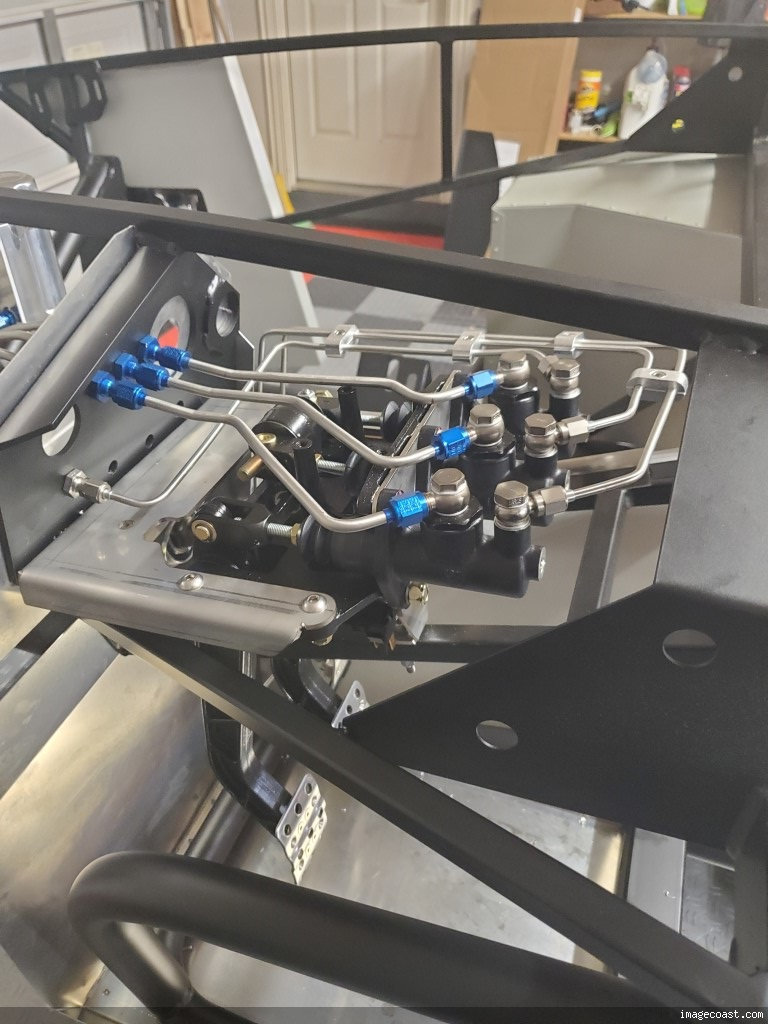
This post might be on the longer side but I like to provide the background leading up to my question/concern. As always, would appreciate any guidance and advice. Particularly since brakes are not something I feel I should be careless about.
A couple months ago, after considerable research through threads and posts in the forum I decided to run my plumbing with stainless steel tubing and with AN single flares. I understood this was a "delicate" process that had to be done right, so I got the right tools and material (soft-annealed, seamless, 0.028'' thickness) and made sure to DM some of the SS experts in here to check that I was doing my flares correctly. During my bleeds there were no leaks, if I rolled the car and hit the brakes it would stop, and I could slam on the brakes hard and no fitting busted open. Still, I left paper diapers under every fitting and every time I worked on the car, I would pump the brakes a bit to keep testing.
Here is where it began to become somewhat frustrating. Weeks would go by where I would hit the brakes and rub pieces of paper against the fittings and all clean, but then on seemingly random days, one of the diapers showed a tiny brake fluid stain. I was stuck in this cycle of tightening, loosening, re-tightening, bleeding, testing, days without any weeping, and again at random, one day I'd see a bit of brake fluid when rubbing the fitting with paper. I re-did that problematic line 3 times. Thankfully it was the shortest of my SS lines and without any bends. The last time I tightened more than I believed it was recommended and that seemed to have stopped the issues but given the randomness of when I would find the fitting weeping a bit, I realized I needed a more reliable test.
I followed Mike Bray's procedure to modify a cap for the brake reservoirs and hooked it to a Motive Power Bleeder, that way I can pump it to something like 10 PSI and force any leaks to show themselves instead of waiting, as well as checking if the pressure drops. Here is where it gets confusing. My first day, I find that for both front and rear brake systems, I'm dropping around 1 PSI every 9 to 12 minutes. I finally find some fittings actually wet, so I tighten those, and I rub paper on all fittings and found small weeping in one of the master cylinders and then on 2 different bleeder screws (not the nipple where you bleed but where it bolts to the caliper) of the Wilwood brakes. I decide to get an AN cap to seal one of the lines that kept giving me issue, to try to find if the problem was my flare on the line or if the surface of the T fitting was compromised. I re-do my tests, I find absolutely no leaks or weeping on the rear brakes, and yet I'm still dropping about 1 PSI every 9 to 12 minutes. I suspect that the Motive is leaking somewhere, so I created a little jig with the problematic line. I cap one end and hook up the other directly to the Motive Power Bleeder while all the connections are underwater. The first time there were plenty of bubbles, so I tighten everything until I get no bubbles. However, I still got about 1 PSI drop in 11 minutes. Seems that this Motive Bleeder will always have that pressure drop, the leak must be in the bottle's pump or where it connects to the vinyl tubing since I had every other connection underwater.
What confuses me is, what about those micro-leaks/weeping that I found when I pressure-tested the lines on the car? I re-did the tests, rubbed paper against the fittings, and again found nothing on the rear brakes, and micro-weeps if I jammed the edges of paper into the fittings, but still for both between 1 PSI drop between 9 to 12 minutes. If I test the one with the micro-weeping with soapy water, no bubbles are created. As I mentioned in the beginning, I don't want to be careless with the brake system but I don't know what else to do other than continuously re-doing lines until there are no micro-weeps. Even if the Motive Power Bleeder can't maintain pressure for more than 10 minutes, if anything in the actual lines had a leak, I should be dropping pressure faster. Is this acceptable? Can I continue? The bleeder screws and master cylinder didn't weep these last few pressure tests, not sure how they "fixed" themselves. My next step is to get a pressure gauge and test on every caliper if I'm getting +1000 PSI when I slam on the brakes. Would these two tests combined provide enough proof of a brake system that will stop a car at any speed? I feel the answer is "nope, there can't be anything wet at all, re-do this".
When you pump the brakes up for your leak test you heat the fluid. Are you sure your 1 psi drop is not just the fluid cooling off? If it keeps dropping I would say you have a leak but if it stabilizes it's just a temperature change causing a pressure change.
Ugh, that sucks. I've never tried doing anything but the tried/true nickel-copper lines, so I hope someone can help you. Looking forward to their advice.
Reminds me of times I've "upgraded" to something fancy.. and it's not worked as well as normal. I don't know if it's because nicopp is softer and conforms better with the flares, but I haven't touched mine since the very first day I assembled them - the nicopp systems just never seem to leak.
James
FFR33 #997 (Gen1 chassis, Gen2 body), license plate DRIVE IT says it all! build thread
My build: 350SBC, TKO600, hardtop, no fenders/hood, 32 grill, 3 link, sway bars, 355/30r19
Previous cars: GTD40, Cobra, tubeframe 55 Chevy, 66 Nova, 56 F100
What tool did you use to make your flares? Can you take a photo of the flare surface at about 100x magnification? EDIT: Should be testing your brake lines at about 1000psi. EDIT 2: Lots of line is sold as seamless when in fact it is not, but instead has the seam polished out. The 100X flare photo will show if it has a seam. Here are two photos of the sealing surface at 100X. One was done with an eastwood tool and the other a rigid. Both would pass in initial low pressure leak test (sub 500psi), but the eastwood flare will gradually seep over time. DSC00017 (640x425).jpgDSC00008 (640x404).jpg
EDIT 3: I see you have stainless fittings too. If your flares and fittings are good it may be a simple as more torque. Stainless fittings with stainless lines have higher surface hardness and therefore are a bit harder to seal, generally requiring more torque than aluminum or NiCop. Not a problem though as stainless fittings and line can take quite a bit of torque without damage.
Last edited by mikeinatlanta; 06-28-2023 at 02:17 PM.
MKII "Little Boy". 432CI all aluminum Windsor. .699 solid roller, DA Koni shocks, aluminum IRS, Straight cut dog ring T-5, 13" four piston Brembos, Bogart wheels. BOOM!
When you pump the brakes up for your leak test you heat the fluid. Are you sure your 1 psi drop is not just the fluid cooling off? If it keeps dropping I would say you have a leak but if it stabilizes it's just a temperature change causing a pressure change.
If I let the pressure test run for 20 minutes then I drop ~2 PSI.
Originally Posted by mikeinatlanta
What tool did you use to make your flares? Can you take a photo of the flare surface at about 100x magnification? EDIT: Should be testing your brake lines at about 1000psi. EDIT 2: Lots of line is sold as seamless when in fact it is not, but instead has the seam polished out. The 100X flare photo will show if it has a seam. Here are two photos of the sealing surface at 100X. One was done with an eastwood tool and the other a rigid. Both would pass in initial low pressure leak test (sub 500psi), but the eastwood flare will gradually seep over time. DSC00017 (640x425).jpgDSC00008 (640x404).jpg
Here is the most magnification I could get from my phone:
What tool did you use to make your flares? Can you take a photo of the flare surface at about 100x magnification? EDIT: Should be testing your brake lines at about 1000psi. EDIT 2: Lots of line is sold as seamless when in fact it is not, but instead has the seam polished out. The 100X flare photo will show if it has a seam. Here are two photos of the sealing surface at 100X. One was done with an eastwood tool and the other a rigid. Both would pass in initial low pressure leak test (sub 500psi), but the eastwood flare will gradually seep over time. DSC00017 (640x425).jpgDSC00008 (640x404).jpg
EDIT 3: I see you have stainless fittings too. If your flares and fittings are good it may be a simple as more torque. Stainless fittings with stainless lines have higher surface hardness and therefore are a bit harder to seal, generally requiring more torque than aluminum or NiCop. Not a problem though as stainless fittings and line can take quite a bit of torque without damage.
I saw your EDIT 3 after I had posted my reply. One of the problematic connections (it's only 2) is the "right" outlet of a T fitting, since I felt I had nothing to lose at that point I continued torquing it. I guess so much that it rotated the T enough that it bent the SS feeding into that T, and I had the fitting held with a 3/8'' wrench! Not sure how much more I could torque it but I guess I could try and figure out a better way of holding the T.
Hold the Tee with an over size adjustable wrench.
On first tightening a flare, wet the taper with brake fluid, tighten firmly, back off and re tighten.
No leaks.
20th Anniversary Mk IV, A50XS Coyote, TKO 600, Trunk Drop Box, Trunk Battery Box, Cubby Hole, Seat Heaters, Radiator hanger and shroud.
I have only added AN ends to lines I made, never the actual flares, but bottom line: leaky no bueno. Keep doing, redoing, tightening. Personally, I would ignore the PSI drop since your setup for testing has several points for failure that will confound things. I don't always understand it, but sometimes...it takes time. I did nickel copper, but I bled, tested and all good. 3 days later, a droplet in 1 place. A few more pounds of torque and seemed good. 3 days later a droplet. Added a few more pounds of torque and been good since. Just keep swimming...
The eastwood tool is an issue. Maybe ok for aluminum or nicop but not stainless. what you need to do is to get a sealing surface finishing tool and grind your sealing areas on the flares. As already stated, pressure testing with nitrogen should be at 1000 psi minimum. A sealing washer may get you there, but not an optimal solution. Happy to help further through pm, but not willing to go much further in public. You are getting some bad information in this thread.
I have a very similar problem. Maybe it's the Texas heat... I opted for stainless tubing and stainless steel AN fittings. Based on many recommendations on this forum, I used the Eastwood pro-flare. It took a bit of practice; pulling the handle all the way split the SS tube every time. I needed to find the "sweet spot" and closely examined each flare before tightening. When I first bled the brakes using the Phoenix Systems MaxPro HD Reverse Brake Bleeder, I had a few minor leaks. Tightened everything up and no problem. Then one week later, when I wiped a fitting or two, there was a small amount of fluid present. Tighten some more, no problem; a week later a small amount of fluid. Pumping the brakes hard does not seem to change the amount of fluid (really small) that appears - nothing at first, then a very small amount after a week or so. Also no bubbles now in the MC after bleeding. At first I thought it could be due to the fact that I used a single 37 degree flare on the SS tubing and not a double flare. Tried to make a double flare like with the nicop and it was impossible. I don't know if such a small amount of fluid is a leak, though I'm not comfortable with it, but I don't want to take everything apart only to have the same thing occur.
David...
Last edited by DIBaledo; 06-29-2023 at 03:28 AM.
MK4 Roadster Delivered 11/28/2022
Ford Racing Aluminator A52XS; T56 Magnum
IRS; Billet IFS; QA1 Double Adjustable Shocks; Wilwood Big Brakes from Gordon Levy
Slowly building my dream
The eastwood tool is an issue. Maybe ok for aluminum or nicop but not stainless.
I've never used the Eastwood tool but I would tend to agree with this statement. For stainless steel (or titanium) tubing I use a flaring tool that has rollers in the forming head. After forming the flare it is run in reverse while still under pressure to burnish the material. https://imperial-tools.com/products/...flaring-tools/
I have a very similar problem. Maybe it's the Texas heat... I opted for stainless tubing and stainless steel AN fittings. Based on many recommendations on this forum, I used the Eastwood pro-flare. It took a bit of practice; pulling the handle all the way split the SS tube every time. I needed to find the "sweet spot" and closely examined each flare before tightening. When I first bled the brakes using the Phoenix Systems MaxPro HD Reverse Brake Bleeder, I had a few minor leaks. Tightened everything up and no problem. Then one week later, when I wiped a fitting or two, there was a small amount of fluid present. Tighten some more, no problem; a week later a small amount of fluid. Pumping the brakes hard does not seem to change the amount of fluid (really small) that appears - nothing at first, then a very small amount after a week or so. Also no bubbles now in the MC after bleeding. At first I thought it could be due to the fact that I used a single 37 degree flare on the SS tubing and not a double flare. Tried to make a double flare like with the nicop and it was impossible. I don't know if such a small amount of fluid is a leak, though I'm not comfortable with it, but I don't want to take everything apart only to have the same thing occur.
David...
Sorry to hear you are going through the same thing, but we gotta figure something out. With the random and intermittent behavior, I don't feel very comfortable even if I re-do the lines. The proof is in the pudding and a pressure test is the true conclusive answer. If there are no leaks then you don't drop pressure. What I'm confused about now is if I have a defective Motive Power Bleeder as any usage of it gives me a constant pressure drop, or if that's what's expected out of this product, because if so, then I don't have a pressure drop since I'm getting the same when I test the actual lines on the car and when I do a test with a short piece underwater.
Originally Posted by mikeinatlanta
The eastwood tool is an issue. Maybe ok for aluminum or nicop but not stainless. what you need to do is to get a sealing surface finishing tool and grind your sealing areas on the flares. As already stated, pressure testing with nitrogen should be at 1000 psi minimum. A sealing washer may get you there, but not an optimal solution. Happy to help further through pm, but not willing to go much further in public. You are getting some bad information in this thread.
I've never used the Eastwood tool but I would tend to agree with this statement. For stainless steel (or titanium) tubing I use a flaring tool that has rollers in the forming head. After forming the flare it is run in reverse while still under pressure to burnish the material. https://imperial-tools.com/products/...flaring-tools/
I see a few Imperial flaring tools, is there a specific one that you recommend?
I also wanted to ask you, since my pressure testing is based on your setup with the Motive Power Bleeder and the modified cap with the thicker grommet (per your suggestion). Were you able to maintain pressure for more than 10 minutes or are these Motive bottles expected to drop a certain amount of pressure after 10 minutes or so?
Last edited by elspanishgeek; 06-29-2023 at 11:18 AM.
I see a few Imperial flaring tools, is there a specific one that you recommend?
I also wanted to ask you, since my pressure testing is based on your setup with the Motive Power Bleeder and the modified cap with the thicker grommet (per your suggestion). Were you able to maintain pressure for more than 10 minutes or are these Motive bottles expected to drop a certain amount of pressure after 10 minutes or so?
As far as leak down with the Motive Power Bleeder, once I installed the thicker gasket I had none. It would hold pressure for hours. I don't think we're apples to apples though. I changed my MCs to Tilton 76 models and I've got stainless tubing running from the reservoirs to the MC's whereas the Wilwood's FFR supplies use rubber hoses. Under pressure from the reservoirs the FFR setup may not be as airtight as the Tilton cylinders with all AN fittings.
As far as leak down with the Motive Power Bleeder, once I installed the thicker gasket I had none. It would hold pressure for hours. I don't think we're apples to apples though. I changed my MCs to Tilton 76 models and I've got stainless tubing running from the reservoirs to the MC's whereas the Wilwood's FFR supplies use rubber hoses. Under pressure from the reservoirs the FFR setup may not be as airtight as the Tilton cylinders with all AN fittings.
The link works, it's just that the Imperial website hasn't renewed the SSL encryption so the browser warns you and tells you that it can't guarantee the website owner is who they say they are. It just expired too, on June 22nd, 2023. I'm scanning a few online stores and they are around $500. Have you used lapping tools like the one @mikeinatlanta suggested? That's a more palatable $150.
As for the Motive question, you definitely have a way better system but I still think you answered my question. There's a video in my first post where I tested the Motive with a similar simple connection all underwater. Basically, everything enclosed in green in the pic below was underwater, I monitored for 10 minutes and saw no bubbles and yet the Motive pressure gauge dropped approximately 1 PSI in 10 minutes. So there has to be a small leak in either the tubing connection to the bottle, the pump cap, or the pressure gauge. I've reached out to Motive, let's see what they say.
I think I need a definitive way of testing that there is no pressure drop. What's very confusing is the Motive bottle is dropping ~1 PSI every 10 minutes, regardless of what it is hooked to, and that was the same pressure drop when I was testing system on the car, so if I had an issue with the lines or fittings I should have gotten a pressure drop faster than ~1 PSI every 10 minutes but I didn't.
I'm scanning a few online stores and they are around $500. Have you used lapping tools like the one @mikeinatlanta suggested? That's a more palatable $150.
$500 sounds about right. I bought mine literally about 40 years ago for around $100 which was way more than I had at the time!
I've never used anything else since I had the burnishing tool. Sorry.
Anyone considered using Swagelok fittings on their stainless steel tubing? In my 45 year engineering career I did a lot of high pressure testing and never had an issue with leaks or failures. In the smaller tubing sizes we would test to 10,000 psi.
Other than cleaning off the burr from cutting the tubing nothing special is needed in the way of tools for a Swagelok compression fitting
Anyone considered using Swagelok fittings on their stainless steel tubing? In my 45 year engineering career I did a lot of high pressure testing and never had an issue with leaks or failures. In the smaller tubing sizes we would test to 10,000 psi.
Other than cleaning off the burr from cutting the tubing nothing special is needed in the way of tools for a Swagelok compression fitting
I tried using Swagelok fittings on my fuel hanger and collapsed the lines in the process of torquing them. Had to take it all out and went with a different hanger that came with -6 AN connections already.
So, to make things more interesting I suppose, after @Mike.Bray's response that his Motive bottle could hold pressure for hours I decided to test my entire Power Bleeder. Sure enough, the connection of the pressure gauge to the plastic bottle has been leaking all along. Sealed it with silicone, repeated my pressure test on each of the systems (front brakes and rear brakes from reservoir to caliper), and both held 10 PSI for 45 minutes. I still got the lapping tool that @mikeinatlanta suggested and will seal the surfaces of the 2 connections that were micro-weeping, but I'm kinda confused, does this mean I never had a leak in the first place?
I know 10 PSI is not the +1000 PSI I need to validate, though. This week I'm receiving the pressure gauge that hooks to the bleeder screws and will test what it reads when I slam on the brakes. If all calipers reach at least 1000 PSI and I can hold the 10 PSI for 45 minutes without any drop, can I consider the brakes to be safe enough?
Don't know that I'd leave 1,000psi on most calipers. That said, there really is no such thing as "micro weeping". Either it leaks or it doesn't. Static AN fittings should hold 1,000psi for months, not minutes.
MKII "Little Boy". 432CI all aluminum Windsor. .699 solid roller, DA Koni shocks, aluminum IRS, Straight cut dog ring T-5, 13" four piston Brembos, Bogart wheels. BOOM!
Mike,
You have it mastered on AN fittings. Coming from the rocket/aerospace industry those are one of the best I have seen. I might hit you up for some guidance; I want to do 37 degree in the car I'm rebuilding. Super job!
I've never used the Eastwood tool but I would tend to agree with this statement. For stainless steel (or titanium) tubing I use a flaring tool that has rollers in the forming head. After forming the flare it is run in reverse while still under pressure to burnish the material. https://imperial-tools.com/products/...flaring-tools/
Rigid also does this except with a slightly different process. The Rigid uses a single head that rolls around to form the flare and burnishes at proper depth in the forward direction. Haven't tested the imperial, but expect either would be vastly superior to tools like the Eastwood.
MKII "Little Boy". 432CI all aluminum Windsor. .699 solid roller, DA Koni shocks, aluminum IRS, Straight cut dog ring T-5, 13" four piston Brembos, Bogart wheels. BOOM!
Following up on this. I got the lapping tool and used it on one of the weeping connections on the front brake line, also re-did one of the rear brake lines and likewise lapped the new flares with it. Here's a pic, left one has been lapped:
As you can see from the slow-mo videos or screenshots, I got peak readings at 1,500 PSI on both front and rear brakes.
I think this means I'm all set but still want to check with the experts if my results mean what I think they mean. Holding pressure means I don't have any significant leaks and both front and rear brake systems (lines, fittings, etc) are able to withstand and deliver the minimum PSI requirement in order for the car to be safe to drive.
To close the thread (hopefully), I re-did the manometer test at the calipers but this time holding the foot down as opposed to slamming it. I was able to get the front calipers to hold at around 1100 PSI and the rear ones at around 1000 PSI. I did find a leak in the Wilwood MC 1/8'' NPT port to the elbow fitting that connects to the rear brake stainless steel tubing. I couldn't have torqued that fitting any more, so I took it out and replaced the Teflon I had on it with Permatex Hydraulic Sealant (54540). I let it dry on the threads for 12 hours and then back on the MC. The unfortunate conclusion that I gather from this is that using a Motive Power Bleeder bottle is useless at finding leaks since I was able to hold 10 PSI for hours.
I also took this as an opportunity to test all my fuel lines since they still haven't seen fuel yet. Lapped the flares on the stainless steel ones and also got Earl's 6AN pressure tester kit and tested every connection in the fuel system, flex and hard lines, at 150 PSI under water. No bubbles, no drop in pressure.



 Thanks:
  Likes:

 Brake Lines - Testing & Issues


 Reply With Quote
 Originally Posted by Dgc333